
What Business Workflows Should You Automate First?
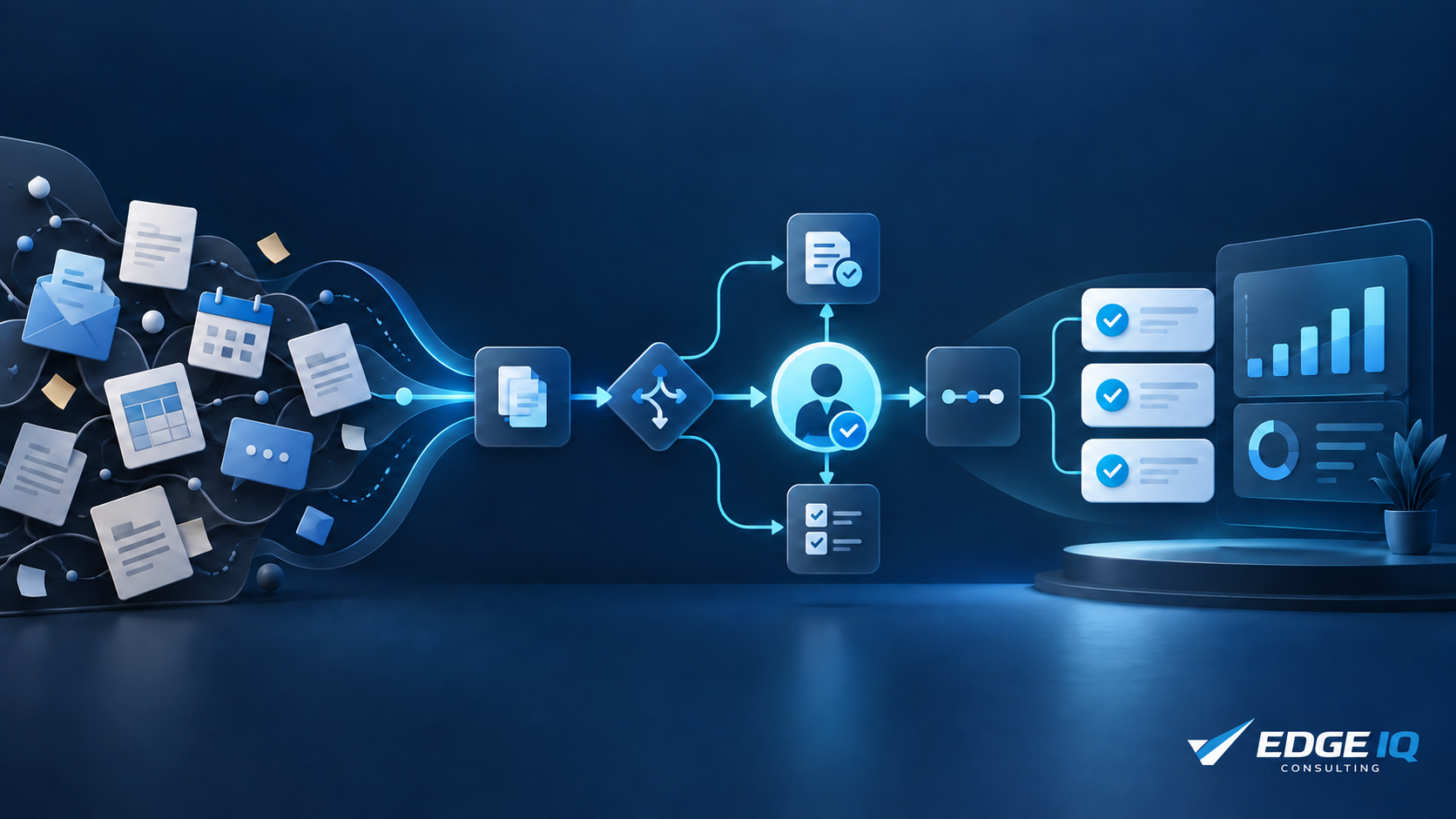
Running a growing business creates an odd problem: success often produces more administrative work.
Employees spend time copying information between systems. Managers chase updates and approvals. Owners become the final stop for decisions, customer questions, scheduling problems, and reports.
Everyone stays busy, but important work still gets delayed.
The right automation can reduce that pressure. The goal is not to replace people or automate every task. It is to remove unnecessary work, make responsibilities clearer, and give your team more time for customers, decisions, and the work that actually requires human judgment.
The starting point is not the tool. The starting point is the workflow.
Where does operational friction usually appear?
Workflow friction is any point where work slows down, gets repeated, depends on someone remembering, or requires information to be moved manually. Here are some of the most common examples.

1. Information is copied from one system to another
An employee receives information by email, enters it into a spreadsheet, copies it into a CRM, and then sends parts of it to another person. Each step may only take a few minutes, but it happens repeatedly — and it creates openings for missing fields, duplicate records, and typing errors.
A better workflow can capture the information once and route it to the appropriate system. Exceptions or low-confidence items can still be sent to a person for review.
2. Follow-up depends on someone remembering
A prospect requests information. A customer asks for an update. A vendor promises to send a document. Someone intends to follow up later, but no task or reminder is ever created. This is rarely an employee-effort problem — it is usually a process problem.
The remedy may be a defined follow-up trigger, an assigned owner, a due date, and an escalation when the task remains incomplete. Automation can create the reminder and move the information. A person can still handle the conversation.
3. Work sits while waiting for approval
Invoices, estimates, purchases, schedule changes, customer exceptions, and pricing decisions frequently wait for an owner or manager. Some approvals genuinely need leadership judgment. Others can be routed using clear rules.
Routine requests that meet defined conditions might proceed automatically, while unusual, expensive, or high-risk requests are escalated. This preserves decision authority without making the owner the bottleneck for every transaction.
4. Email has become the company's workflow system
Shared inboxes often hold customer requests, internal assignments, documents, approvals, and unresolved questions. Important messages compete with routine notifications and junk.
A practical automation can classify incoming messages, identify the customer or project, create a task, assign responsibility, and flag urgent or ambiguous messages for human review. The inbox stays a communication channel instead of becoming an unreliable task-management system.
5. Reports are rebuilt manually
Many businesses have a weekly or monthly report that someone creates by exporting files, copying numbers, formatting spreadsheets, and writing the same basic commentary. This work is measurable and often highly repeatable.
A connected reporting workflow can collect the required information, update a dashboard, identify missing data, and prepare a review-ready summary. Management still interprets the results and decides what to do next.
6. Customers ask for updates your systems already contain
Customers call or email to ask whether an appointment is confirmed, a job has been scheduled, an order is ready, or a document has been received. These questions add to the workload even when the answers already exist somewhere in the business.
Status notifications can be triggered at useful points in the process. Customers receive timely information, while unusual cases remain available for personal attention.
7. Onboarding and closeout involve too many disconnected steps
A new customer, project, employee, or vendor can trigger a long list of tasks:
- Collecting information
- Creating folders and records
- Scheduling meetings
- Assigning responsibilities
- Sending instructions
- Requesting documents
- Granting or removing access
- Completing final billing and archiving
When these steps live in someone's memory, inconsistency is almost guaranteed. A defined checklist with automated task creation, reminders, document routing, and exception handling makes the process more reliable without removing human oversight.
Should every repetitive task be automated?
No. Some work should remain human because it involves judgment, relationships, sensitive information, financial consequences, or safety concerns.
Before automating a workflow, ask:
- What triggers the process?
- Who owns each step?
- What information is required?
- Where does the work stop or wait?
- What happens when the normal process fails?
- Which decisions require human approval?
- How will the business know the workflow is working?
A responsible automation includes an exception path. If information is incomplete, confidence is low, or a decision exceeds a defined threshold, the work should move to the right person. Automation should make responsibilities clearer — not hide the process inside another piece of software.
Start with the workflow that creates the most friction
Trying to automate an entire company at once usually creates unnecessary complexity. A better approach is to identify a single workflow that is:
- Repeated frequently
- Creating a noticeable workload
- Prone to delays or errors
- Important to the customer experience
- Simple enough to improve without disrupting the business
- Measurable before and after the change
The simplest solution may be a better use of software you already own. It may be a clearer process, a shared dashboard, a system integration, a rule-based automation, or an AI-assisted step with human review. The objective is to solve the operational problem — not add technology for its own sake.
How Edge IQ Consulting helps bridge the gap
Edge IQ Consulting helps small and owner-led businesses understand how work moves through the organization before recommending a solution. Our EDGE Framework provides a practical path:
Evaluate. Understand the business goals, current systems, team readiness, and the areas creating the most pressure.
Discover. Map the workflow, handoffs, delays, repetitive steps, exceptions, and points where work depends on one person.
Generate. Compare practical improvement options and prioritize them by value, complexity, risk, and fit.
Execute. Implement the selected improvements with documentation, training, human review points, and a way to measure performance.
An EDGE Audit provides a clear view of what is slowing the business down, which opportunities should come first, and what should remain under human control. Instead of a list of disconnected software recommendations, the business gets a prioritized improvement roadmap grounded in how the team actually works.
Give your team time for the work that matters
Employees should not spend their best hours copying information, searching for status updates, or rebuilding the same report. Managers should not have to chase every handoff. Owners should not be the workflow that holds the company together.
The right automation reduces that burden while keeping people involved where their experience and judgment matter most.
Not sure what to automate first? Start with the EDGE AI Readiness Scorecard, then book a 15-minute AI Fit Check. We'll talk through where work is getting stuck, whether automation is the right answer, and whether an EDGE Audit would give your business a clearer path forward.
Find My Best Automation OpportunitySchedule a 15-Minute AI Fit Check