What a hidden address changes, what it does not, and what to show AI tools instead.
No. Keeping your home or yard address off Google does not, by itself, keep ChatGPT or Google’s AI from recommending you. In BrightLocal’s 2026 study, service-area businesses were mentioned 29.4% of the time, against 33.6% for storefronts. The gap is small and the study did not test its cause. Keep the address private and name your towns everywhere.
A Search & AI Visibility Audit looks for gaps in how a business is represented. It does not promise a ranking or an AI citation.
The short answer
If customers never visit your home or yard, hiding the address is the right setup. Privacy is reasonable. The rest of your business information just has to do the work.
What did the BrightLocal study find?
BrightLocal tracked about 200,000 local AI searches across about 1,300 locations over 60 days, in many kinds of businesses, not trades alone.
| AI tool | Storefront | Service-area business |
|---|---|---|
| ChatGPT | 33.7% | 29.4% |
| Google AI Mode | 31.9% | 27.4% |
| Google AI Overviews | 38.4% | 36.9% |
| All three | 33.6% | 29.4% |
BrightLocal’s own heading says storefronts are mentioned more “but not by much.” BrightLocal sees a fixed address as helpful, but the study shows an association, not a tested cause. BrightLocal sells AI visibility tracking, so treat this as directional vendor research.
Should you hide your address on Google?
Yes, if customers never come to you. Google says: “If you don’t serve customers at your business address, remove your address from your Business Profile.” If customers visit a shop or yard with permanent signage, show the address and add service areas. We do not tell a contractor to publish a home address just to satisfy an algorithm.
What should you show AI tools instead?
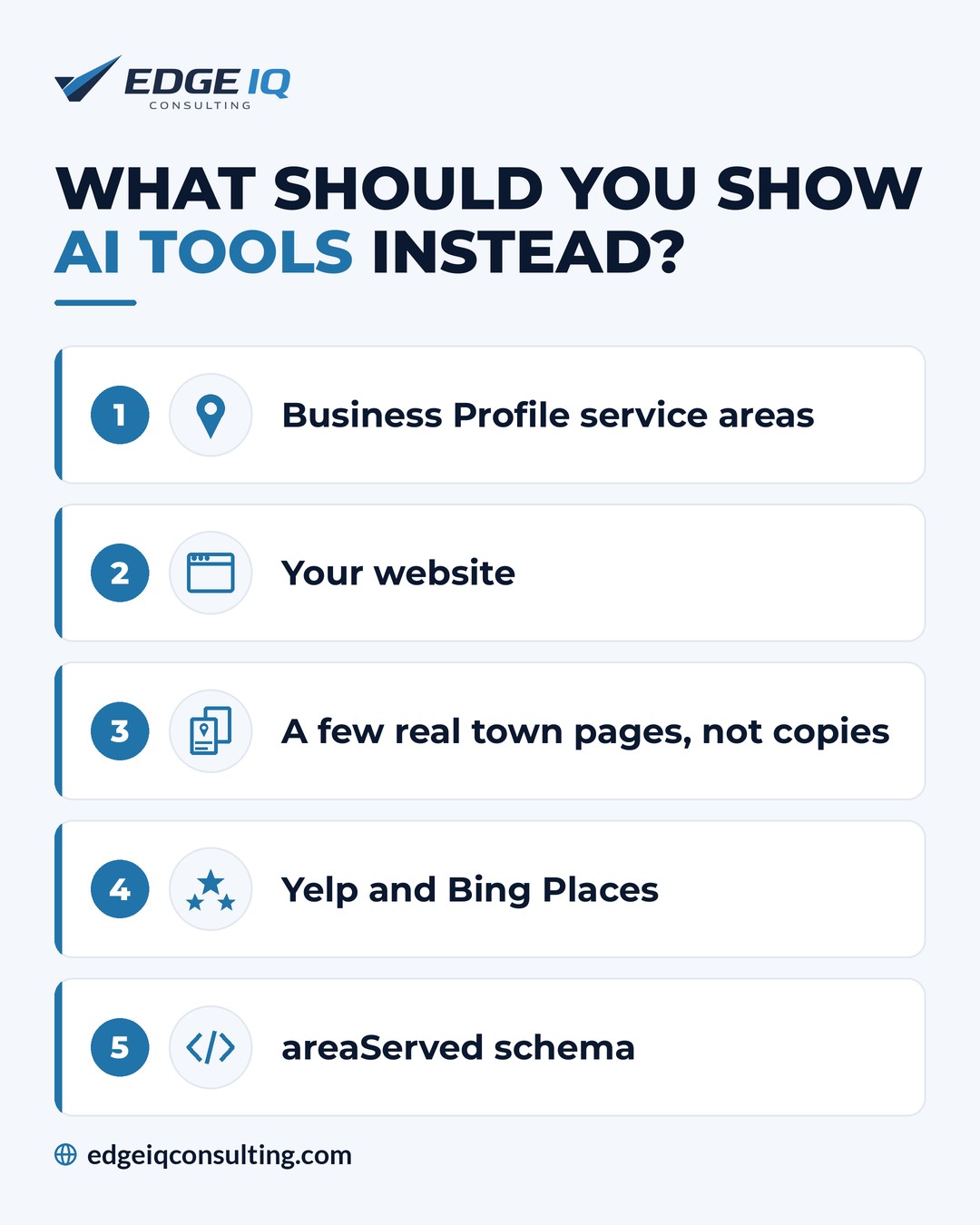
Keep the private address off, and make your real towns obvious everywhere AI tools look. To see what they say about you now, read Does AI know your business?
Set your service areas on your Business Profile
Google allows up to 20 service areas by city or ZIP code, within about 2 hours’ drive. BrightLocal found Google’s AI tools often use the profile. List only towns you actually serve. Our Business Profile checklist covers each field.
Name your towns on your website
BrightLocal found business websites accounted for 42% of the sources AI answers cited. Put your trade and towns in plain text, such as “Serving Owasso, Collinsville and Sperry,” on your home and contact pages. Our guide to how AI tools read a contractor website goes further.
Write a few real town pages, not copies
Start with the 3 to 5 towns that bring the most work. Give each real jobs and photos, local problems and the same phone number. If the only change is “Tulsa” becoming “Owasso,” the page is filler.
Put the same towns on Yelp and Bing Places
BrightLocal found ChatGPT hardly uses the Business Profile and leans on sources like Yelp and Bing. Keep the same name, phone, hours and towns on each, with the address hidden.
List your towns in schema with areaServed
schema.org defines areaServed as “The geographic area where a service or offered item is provided.” Ask your web person to add it with no street line. Schema can clarify your service area. It cannot manufacture local relevance.
What will not help?
- A virtual office or mailbox. Google’s guidelines do not allow an unstaffed virtual office or a remote mailbox, and the profile can be suspended.
- A second profile for each town. Google wants one profile, with service areas listed.
- Towns far from base. BrightLocal found a little over half of picks were within about 3 miles of the searcher.
- Anyone who promises AI will name you.
How do you check, town by town?
Pick 3 to 5 towns. Ask ChatGPT and Google the questions customers ask, with the town in them, three times each in a fresh chat. Log whether you were named and the sources cited, fix those sources, and repeat monthly. BrightLocal found only 23% overlap between repeat ChatGPT runs, so one answer is a snapshot.
We hide our address too
Edge IQ Consulting is based in Skiatook, Oklahoma, and our Google Business Profile is set up as a service-area profile with the address hidden. Our website lists Skiatook, OK 74070 and (918) 600-4775, and we do not publish a street address.
Where does Edge IQ Consulting fit?
That town-by-town check is the work we do. A Search & AI Visibility Audit, available to businesses anywhere, checks your Business Profile service areas, the towns on your Yelp and Bing listings, and the areaServed in your schema, plus your website, maps, AI answers and three local competitors.
You keep the report and a prioritized 90-day plan. Remediation is optional: do it yourself, with anyone you choose, or through our 90-Day Visibility Remediation.
FAQ
Does hiding my address on Google stop ChatGPT from recommending me?
Not by itself. In BrightLocal’s study, ChatGPT mentioned service-area businesses 29.4% of the time against 33.7% for storefronts, a small gap with no tested cause.
Should I make my home address public so AI tools recommend me more?
No. Google says to remove your address if you do not serve customers there, and no study we read shows that publishing it gets a business named. Name your towns instead.
Can Google’s AI Mode and AI Overviews recommend a business with no address?
Yes. In BrightLocal’s study, service-area businesses were still mentioned in both, a little below storefronts (27.4% in AI Mode, 36.9% in AI Overviews).
How many towns can I list on my Google Business Profile?
Up to 20 service areas, by city, ZIP code or area, within about 2 hours of driving from your base, Google says.
Can I use a virtual office or mailbox to get a pin in a bigger town?
No. Google’s guidelines do not allow a virtual office unless it’s staffed during business hours, and remote mailboxes are not acceptable.
Do I need a page for every town I serve?
No. Start with a few real pages for your busiest towns. A page that only swaps the town name adds nothing.
What is areaServed schema, and do I need it?
It’s structured data listing the towns you serve; schema.org calls it “the geographic area where a service or offered item is provided.” It does not ensure an AI mention and should never include a private address.
How can I find out whether AI tools name my business in my towns?
Ask your customers’ questions, with the town in them, three times each in ChatGPT and Google. Answers change between runs, so look for a trend. A Search & AI Visibility Audit runs this testing for you and checks your Business Profile service areas, Yelp and Bing towns, and areaServed, without promising a mention.
Related guides
Keep the address private and name your towns everywhere. The goal is to make accurate business information easy to find and easy to trust.
A Search & AI Visibility Audit looks for gaps in how a business is represented. It does not promise a ranking or an AI citation.
Edge IQ Consulting · Skiatook, OK 74070 · (918) 600-4775 · Todd@edgeiqconsulting.com
Hear it first, then map your call flow.